
Which Filling Material Makes Sense for Your Tooth?
An intact, functioning amalgam filling generally should not be removed solely because it is old, silver-colored, or contains mercury.
By Dentist Track · Updated August 16, 2026
Editorial note: This article is an educational synthesis of the cited government, insurer, and dental-practice sources. It has not been presented as an individualized diagnosis or as having undergone licensed clinical review.
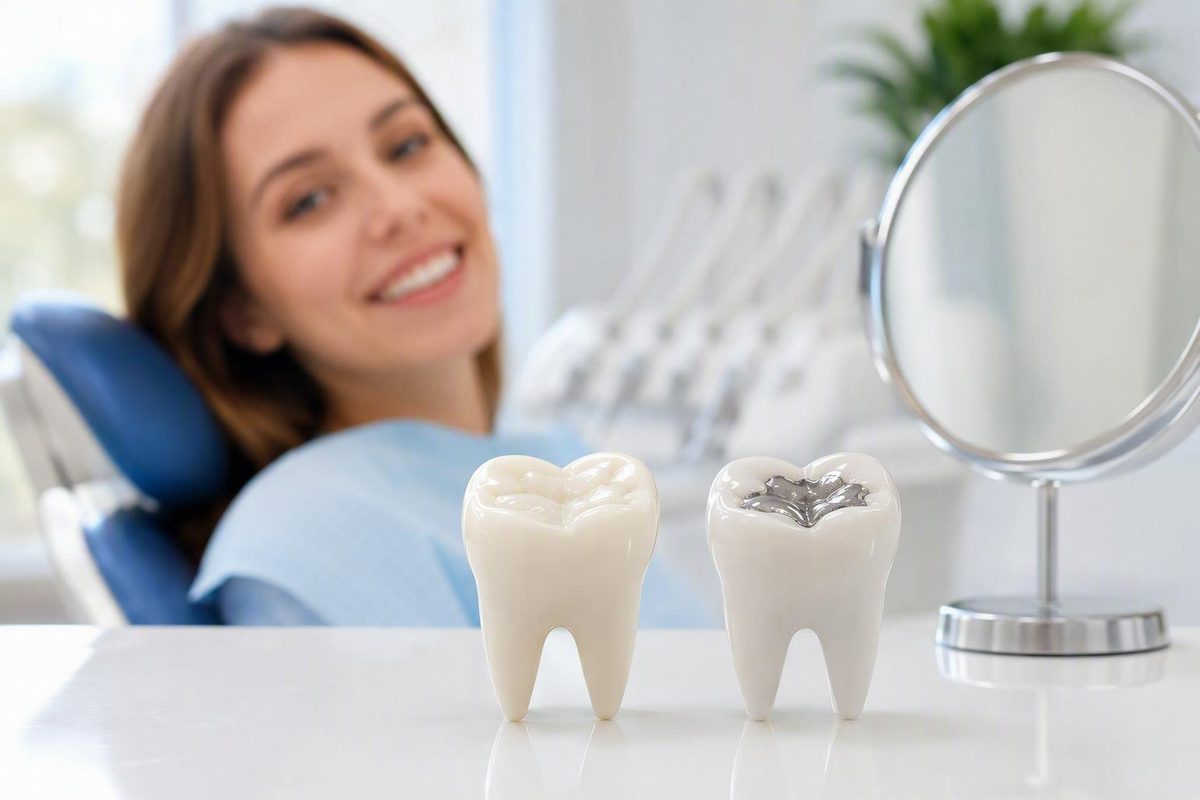
White composite and silver amalgam fillings can both restore teeth affected by decay, but neither material is best in every situation. Composite is commonly preferred when natural appearance and adhesive bonding matter. Amalgam may still be considered for selected restorations that are large, heavily loaded, difficult to keep dry, or sensitive to upfront cost.
The choice depends on more than whether the tooth is visible. A dentist must consider the cavity’s size and location, the amount of sound tooth remaining, bite forces, grinding, moisture control, procedure tolerance, health considerations, personal preferences, and insurance benefits.
White vs. silver fillings at a glance
There is no universal winner in the debate over white versus silver fillings. A small cavity in a visible tooth presents a different problem from a large cavity extending near the gum line in a heavily loaded molar. Even two cavities in the same person may call for different materials.
Composite is the usual tooth-colored option. It can be matched to surrounding enamel and bonded to the prepared tooth. Amalgam is a silver-gray metal alloy retained mainly by the shape of the prepared cavity. It is generally faster to place, more tolerant than composite of difficult moisture conditions, and less expensive upfront.
| Feature | White composite filling | Silver amalgam filling |
|---|---|---|
| Material | Resin matrix containing fine glass or quartz particles | Metal alloy containing approximately 50% elemental mercury plus silver, tin, copper, and sometimes other metals |
| Color | Available in shades intended to blend with the tooth | Silver-gray and visibly different from enamel |
| How it attaches | Adhesively bonded after preparation, etching, and application of a bonding system | Retained primarily by the shape of the prepared cavity |
| Moisture requirements | Reliable isolation is important because contamination can weaken the bond | More tolerant of challenging moisture conditions, although appropriate moisture control is still necessary |
| Placement time | Typically longer because of bonding, incremental placement, curing, shaping, and polishing | Typically faster and involves fewer bonding and curing steps |
| Common clinical uses | Visible teeth and many small or moderate restorations, including many back teeth that can be isolated | Selected large or heavily loaded back-tooth restorations, difficult-to-isolate areas, and cost-sensitive treatment |
| Relative upfront cost | Generally higher, although fees and benefits vary | Generally lower, although fees and benefits vary |
| Major limitations | Technique-sensitive; contamination during bonding can affect the result; may not suit every large or high-stress defect | Noticeable color; mechanically retained; may require preparation for retention; new use may not be preferred for certain higher-risk groups |
| Typical advantage | Natural appearance and adhesive placement | Faster placement, moisture tolerance, and lower initial cost |
| Typical trade-off | More steps and often a higher fee | Visible metal and patient-specific mercury considerations |
These are typical, case-dependent differences—not promises about an individual restoration. Placement quality and conditions inside the mouth can be as important as the material’s name.
A molar does not automatically need amalgam. Modern composite can be used successfully in many back teeth, particularly when the restoration is not excessively large and the treatment area can be kept reliably dry. Conversely, choosing composite solely because it is white may be unwise if dependable isolation cannot be established.
Amalgam can remain a practical option for some large molar cavities, areas under substantial chewing pressure, cavities near or below the gum line, or situations in which a shorter procedure is important. Before comparing materials, however, the dentist should determine whether the damaged tooth is suitable for any direct filling. If too little sound structure remains, an onlay, crown, or another restoration may deserve consideration.
What white and silver fillings are made of
A white filling usually means a direct composite resin restoration. Composite contains a resin matrix reinforced with fine glass or quartz particles. Different shades and opacities allow the dentist to approximate the color of the surrounding tooth.
“White filling” is an informal, appearance-based term rather than a precise material category. Glass ionomer and other materials can also be tooth-colored, but they have different compositions, properties, and clinical uses. Ask whether a proposed white material is composite, glass ionomer, or something else rather than relying on color alone.
Composite is generally placed through an adhesive process. After removing decay and preparing the area, the dentist conditions the tooth and applies a bonding system. Composite is usually added in increments, with each increment hardened by a curing light. The restoration is then shaped, adjusted against the opposing bite, and polished. Parkdale Dental Centre’s practice-based description of composite placement outlines the etching, bonding, shaping, and light-curing steps.
A silver filling is dental amalgam. Despite the nickname, it is not made only—or even primarily—of silver. Dental amalgam contains approximately 50% elemental mercury combined with metals such as silver, tin, and copper. The mercury helps form a workable alloy that can be packed into a prepared cavity and that hardens after placement, according to the Pediatric Dental Center’s material overview.
Elemental mercury in amalgam is not the same substance as methylmercury, the form commonly discussed in connection with contaminated food. That distinction matters when considering exposure, but it does not make amalgam’s mercury content irrelevant.
Unlike composite, amalgam does not depend on the same adhesive bond to enamel and dentin. The dentist prepares the cavity so its shape retains the material, then packs and carves the amalgam.
How appearance, bonding, and moisture control change the choice
Composite’s most obvious benefit is appearance. A dentist can select a shade intended to blend with the natural tooth, making composite a common choice for front teeth, premolars visible in a smile, and other areas where a patient wants to minimize visible dental work.
A close shade match does not necessarily make a filling invisible. The final appearance can be affected by the tooth’s translucency, the restoration’s size and location, staining over time, and color differences between composite and natural enamel. Nevertheless, composite normally provides a much less conspicuous result than silver-gray amalgam.
Its second important distinction is bonding. In plain language, the dentist treats the prepared tooth with an etching and adhesive system that connects the composite to tooth structure. Because the restoration is not retained only by undercuts or cavity shape, bonding often permits a more conservative preparation.
That does not mean composite always requires less removal of healthy tooth in every case. The amount removed depends on where the decay extends, whether an old restoration is present, whether the tooth is cracked or unsupported, and what access is necessary. “Bonded” should not be interpreted as “no drilling” or “no loss of sound structure.”
Why a dry field matters
Composite bonding is sensitive to contamination. Saliva, blood, or fluid from the gums can interfere with adhesive steps and compromise the interface between the tooth and restoration.
A rubber dam is a thin sheet placed around the treatment area to separate the tooth from the rest of the mouth. It is one useful isolation method, but not the only one. The goal is a controlled field in which the dentist can see the preparation, manage moisture, and complete the bonding steps without contamination.
Reliable isolation can become more difficult when:
- The cavity extends near or below the gum line.
- Gum tissue overlaps or bleeds around the treatment area.
- The tooth is far back in the mouth.
- Access is limited.
- Saliva flow is difficult to control.
- A patient cannot comfortably keep their mouth open for an extended period.
- Movement, anxiety, gagging, or other needs make a multistep procedure difficult.
Amalgam is generally more tolerant than composite when ideal isolation is difficult. That does not mean amalgam should be placed in a wet or uncontrolled field. The dentist still needs visibility, access, cleanliness, and appropriate moisture management. The difference is that amalgam does not depend on the same contamination-sensitive adhesive interface.
Why procedure time may matter
Composite generally takes longer to place because it involves more steps: isolation, conditioning, bonding, incremental placement, repeated curing, shaping, bite adjustment, and polishing. Amalgam can generally be packed and carved more quickly.
The difference may be unimportant to someone comfortable with dental treatment. It can matter more when a patient has severe anxiety, a strong gag reflex, difficulty remaining still, or limited ability to keep the mouth open.
Procedure tolerance is only one factor, especially for children. A shorter placement process does not automatically make amalgam the preferred choice for a child. Age, whether the tooth is primary or permanent, available alternatives, applicable health guidance, clinical conditions, and the dentist’s assessment must also be considered.
The practical trade-off is therefore not simply “attractive versus unattractive.” Composite offers color matching and adhesive bonding but requires dependable isolation and more technique-sensitive steps. Amalgam is visible and mechanically retained but may be easier to place predictably under some moisture- or time-challenged conditions.
Choosing by tooth, cavity, and bite—not color alone
The first question should not be “Do I want white or silver?” It should be “What does this tooth need?” The cavity’s extent, remaining sound structure, position, bite load, and treatment conditions establish which options are clinically reasonable. Appearance, convenience, and cost can then help choose among those options.
| Clinical situation | Composite may make sense when… | Amalgam may be considered when… | What else to ask |
|---|---|---|---|
| Small or moderate front-tooth cavity | Appearance matters and the area can be bonded predictably | Rarely preferred because the metal would be conspicuous | Is composite the appropriate tooth-colored material here? |
| Visible premolar restoration | Shade matching is a priority and adequate isolation is possible | Appearance matters less and clinical conditions favor amalgam | How visible will the restoration be when smiling or speaking? |
| Small or moderate molar cavity | The tooth can be kept dry and sufficient structure remains | A shorter procedure or greater moisture tolerance is important | How much chewing load will this part of the tooth receive? |
| Large molar restoration | The dentist believes a bonded direct restoration will have adequate support | Heavy load, difficult isolation, or cost makes amalgam a reasonable direct option | Is a direct filling suitable, or should an onlay or crown be discussed? |
| Cavity near the gum line | The margin can be exposed, controlled, and kept dry | Saliva or fluid control makes adhesive placement less predictable | Can the entire edge of the preparation be isolated? |
| Heavy grinding or clenching | Restoration size and position remain favorable | The defect is large or under substantial chewing stress | How do my bite forces affect the recommendation? |
| Limited ability to tolerate a long visit | Composite can still be completed without compromising technique | Faster placement offers a meaningful practical advantage and amalgam is otherwise appropriate | Can treatment be staged, or is another material preferable? |
| Strong cosmetic preference | Composite is clinically suitable | The patient accepts visible metal in exchange for other benefits | What appearance is realistic, and could the composite stain or wear? |
| Tight budget or limited benefits | Coverage or personal finances make the additional balance manageable | Lower initial cost is a major consideration | What is the estimated patient balance for each option? |
Front teeth and visible areas
For a small or moderate restoration on a visible tooth, composite is usually the straightforward choice because it can be shade-matched and bonded. Its use still depends on the extent of damage. A large fracture or heavily compromised tooth may require a different restoration rather than an oversized direct filling.
Molars and other back teeth
Modern composite is not limited to front teeth. It may be appropriate for many premolars and molars when the cavity is suitable for a direct restoration and the dentist can maintain a dry field. A dentist-authored practice comparison describes composite as useful in many back teeth while retaining amalgam as an option for selected large molar cavities and heavy bite pressure.
Back-tooth placement does not eliminate appearance as a consideration: some molars and premolars are visible during laughing or speaking. At the same time, cosmetic preference cannot overcome inadequate isolation, insufficient support, or an unfavorable bite.
Large cavities and limited remaining tooth
The larger the cavity, the more important the surrounding tooth becomes. A filling needs enough sound structure to contain or support it. If decay, cracks, or an old restoration have removed too much of the tooth, debating filling materials may miss the central issue.
An onlay or crown may sometimes be considered when a direct restoration lacks adequate support. A patient cannot determine this reliably by looking at the tooth.
Bite force and grinding
Either material can encounter problems under unfavorable forces. Tell the dentist if you clench, grind, or have previously broken teeth or restorations.
Grinding does not automatically dictate amalgam. Its significance depends on the restoration’s size, location, thickness, support, and direction of force. The dentist should consider those factors rather than treating grinding as a one-material rule.
A compact decision rule is useful: clinical suitability first; then appearance, procedure preferences, cost, and coverage.
Durability and lifespan: why simple numbers mislead
Amalgam has traditionally been associated with durability in large or heavily loaded restorations. Composite materials and placement methods have improved, and composite can perform successfully in many posterior teeth. Both statements can be true: amalgam may retain practical advantages in some demanding situations without being necessary—or superior—in every molar.
Some patient-facing practice articles give broad estimates of approximately 7–10 years or longer for composite and 10–20 years or longer for amalgam. These are not guarantees or definitive head-to-head findings. The Barrie Smile Centre comparison that reports these ranges also notes that tooth location and care affect longevity.
A single average cannot capture the difference between a small one-surface filling and a restoration replacing much of a molar. Nor can it separate material properties from diagnosis, preparation, isolation, placement, contouring, and bite adjustment.
Factors that can affect service life include:
- Restoration size: Larger fillings face more complex structural demands.
- Tooth location: A front-tooth edge and a molar chewing surface experience different forces.
- Remaining tooth structure: Thin or unsupported enamel can fracture regardless of filling color.
- Placement quality: Contours, contacts, margins, curing, and bite adjustment matter.
- Moisture control: Contamination is particularly important during composite bonding.
- Grinding and clenching: Repeated heavy forces can affect the restoration or surrounding tooth.
- Diet and oral hygiene: These influence the risk of future decay around a restoration.
- Dry mouth and cavity risk: A filling does not make the surrounding tooth immune to decay.
- Follow-up care: Dental examinations allow the restoration and surrounding tooth to be reassessed.
The supplied practice sources differ in whether they describe modern composite as shorter-lived, comparable to amalgam, or successful in many of the same locations. Those differences may reflect restoration size, patient selection, techniques, and commercial perspective. It is more useful to discuss expected performance for a particular tooth than to declare one material universally stronger.
Service life should also be separated from safety. A filling can require treatment because it has worn, fractured, loosened, been lost, or developed decay at an edge. That does not establish that the material itself was inherently unsafe. Conversely, a material’s general safety profile does not guarantee that a particular restoration will last indefinitely.
Instead of asking only, “How many years does this material last?” ask:
- How large will this restoration be?
- How much tooth will support it?
- Will it be under direct chewing pressure?
- Can the area be isolated properly?
- Do my grinding or cavity risks affect the expectation?
- What will the dentist monitor at future examinations?
- If a limited defect develops, would repair be clinically possible?
A dentist cannot promise an exact lifespan but should be able to explain why the proposed material is expected to work under the conditions present in that tooth.
Mercury safety and who should discuss alternatives
Dental amalgam contains approximately 50% elemental mercury and can release low levels of mercury vapor during placement, removal, and chewing. Elemental mercury is incorporated into an alloy with other metals, but its presence should be described accurately rather than minimized or treated as identical to methylmercury exposure from food.
In the United States, the National Institute of Dental and Craniofacial Research summarizes the FDA’s 2019 review of more than 100 studies as finding that amalgam-related mercury exposure did not pose health risks to the general population. NIDCR therefore describes amalgam as safe for most people, not necessarily every person. It also summarizes federally funded studies as finding no statistically significant adverse differences in the measured kidney-function or IQ-test outcomes between children who received amalgam and children who received other restorative materials.
The same U.S. guidance says suitable non-amalgam materials should be considered when possible for new restorations in:
- People who are pregnant.
- People who are nursing.
- Young children.
- People with impaired kidney function.
- People with a pre-existing neurological disease.
- People known to be allergic or sensitive to mercury or another amalgam component.
These are summaries of U.S. guidance and research—not statements that recommendations, availability, or regulations are identical in every country. Because regulatory advice can change, patients and publishers should verify the applicable guidance at the time treatment or publication decisions are made. The details above are summarized by NIDCR’s government health-information page.
Belonging to one of these groups does not establish that an existing amalgam filling has caused harm. It means the patient and dentist should discuss suitable non-amalgam choices when planning a new restoration, provided an alternative can meet the clinical need.
Likewise, describing composite as mercury-free does not mean it is automatically risk-free or appropriate for every cavity. Dental materials differ in ingredients, placement requirements, and possible failure modes. Questions about sensitivity or ingredients should be considered in relation to the actual product and the patient, rather than reduced to labels such as “natural,” “toxic,” or “safe in all circumstances.”
Environmental handling is a separate issue from personal health risk. Dental offices use amalgam-separation and mercury-waste procedures to reduce releases into wastewater and solid-waste streams. Requirements depend on jurisdiction; a New York dental-practice overview notes that dental offices must follow protocols for disposing of mercury-containing amalgam waste. These controls do not by themselves show that an intact filling is harming the person who has it.
If pregnancy, nursing, kidney impairment, neurological illness, or a known material sensitivity applies to you, disclose it before treatment. The dentist can evaluate whether composite, glass ionomer, or another suitable material is appropriate.
Existing silver fillings: keep, monitor, or replace?
An intact, functioning amalgam filling generally should not be removed solely because it is old, silver-colored, or contains mercury. Age may prompt closer assessment, but it does not establish failure.
Removal is irreversible. The dentist must cut around the existing restoration, and additional tooth structure may be lost. Removing amalgam can also temporarily increase mercury-vapor exposure. For those reasons, the FDA does not recommend removing intact amalgam fillings solely to prevent disease, as summarized in NIDCR’s guidance on existing amalgam restorations.
Cosmetic preference is a separate consideration. A person may reasonably dislike the appearance of metal, especially if a filling is visible when speaking or laughing. But elective replacement still has trade-offs:
- Additional tooth structure may need to be treated.
- The replacement may be larger than the original restoration.
- The new restoration will not last indefinitely.
- Direct composite may not be suitable if too little sound tooth remains.
- Insurance may not cover replacement performed only for appearance.
That does not mean amalgam should never be replaced. A dentist may recommend treatment after identifying recurrent decay, fracture, loss of part or all of the filling, substantial wear, leakage, persistent symptoms, or another clinical defect. Whether a limited repair, complete replacement, broader-coverage restoration, or monitoring is appropriate requires an examination.
The dentist may need to inspect the margins, assess symptoms and bite, evaluate the surrounding tooth, and use appropriate dental imaging.
A useful consultation distinguishes among these possibilities:
- Monitor: The restoration is functioning and no current treatment is indicated.
- Consider a limited repair: A dentist determines that the defect can be treated without replacing the entire restoration.
- Replace: Examination identifies a problem that makes full replacement appropriate.
- Change the restoration type: The remaining tooth may not adequately support another direct filling.
If treatment is recommended, ask the dentist to explain the finding, how much sound structure remains, whether a limited repair is possible, and why intervention is preferable to monitoring.
This article provides general dental education, not an individualized diagnosis. Dentist Track’s educational-use notice advises seeking in-person dental attention for persistent pain or swelling rather than relying on online information. A loose or broken restoration should also be examined by a dentist.
Cost, insurance, and questions to ask before treatment
Composite generally has a higher upfront fee than amalgam. Its material, isolation, adhesive steps, layering, curing, and finishing can require additional treatment time. The actual difference varies by dental office, tooth, restoration size, location, and coverage.
A lower initial price does not automatically mean a lower lifetime cost. Future cost depends on how the restoration performs, whether a defect can be repaired, how much tooth remains, and what treatment is required later. Those outcomes cannot always be predicted when the original filling is placed.
Insurance coverage is plan-specific
A dental plan might:
- Cover composite and amalgam at the same benefit level.
- Cover composite on front teeth but apply different rules to back teeth.
- Pay only the amount it would have allowed for amalgam, leaving the patient to pay the difference.
- Restrict coverage according to tooth, surface, replacement frequency, or clinical indication.
- Cover either material subject to the deductible, annual maximum, and coinsurance.
Do not assume that every plan favors amalgam or excludes posterior composite. United Concordia’s insurer overview of filling benefits discusses possible coverage differences, but the actual result depends on the specific policy, jurisdiction, tooth, and procedure.
Before treatment, request a written estimate showing:
- The tooth number.
- The surfaces to be restored.
- The procedure code or description.
- The proposed material.
- The dentist’s full fee.
- The insurer’s allowed amount.
- The estimated insurer payment.
- Any deductible or coinsurance.
- Any amalgam-equivalent benefit limitation.
- The estimated patient balance.
- Whether the estimate is guaranteed or only a pre-treatment projection.
If cost could affect your decision, ask the dental office to obtain a pre-treatment estimate and confirm the benefit with the insurer. Final payment may still depend on eligibility, remaining annual benefits, plan limitations, and the treatment actually completed.
Consultation checklist
Use these questions to move the discussion beyond color:
- How large is the restoration? Ask how many surfaces are involved and whether the defect extends near or below the gum line.
- How much sound tooth remains? The support around the restoration may matter more than the filling material.
- Is a direct filling appropriate? Ask whether another restoration should be considered.
- Can the tooth be kept reliably dry? If composite is proposed, ask how the area will be isolated.
- What forces will the restoration face? Discuss chewing load, clenching, grinding, and prior broken restorations.
- Why are you recommending this material? The explanation should relate to this tooth rather than a blanket preference.
- What alternatives are clinically reasonable? There may be several choices—or only one predictable option.
- What are the principal trade-offs? Ask about appearance, procedure time, expected performance, and future treatment.
- Could a future limited defect be repaired? Repairability depends on the defect and cannot be guaranteed.
- What will insurance cover? Ask about tooth-specific limits and amalgam-equivalent reimbursement.
- What will I pay? Compare estimated patient balances rather than only the office’s full fees.
Also tell the dentist if you are pregnant or nursing; have kidney impairment, a neurological condition, or a known material sensitivity; grind or clench your teeth; or have had repeated problems with prior restorations.
The final decision should be shared. The dentist contributes examination findings, technical assessment, and feasible treatment options. The patient contributes health information, priorities, procedure tolerance, cosmetic preferences, and financial constraints.
Frequently asked questions about white versus silver fillings
Are white fillings the same as composite fillings?
Usually, but not always. In everyday conversation, “white filling” commonly means a tooth-colored composite restoration made from resin and glass or quartz particles.
However, “white” describes appearance rather than a precise material. Glass ionomer and other tooth-colored restorative materials also exist. Ask the dentist for the exact material if its ingredients, expected performance, appearance, or insurance treatment matters to you.
Which filling is usually better for a back molar?
It depends on the cavity’s size, the remaining tooth structure, bite pressure, grinding, and whether the tooth can be kept dry.
Composite may be suitable for many small or moderate molar restorations when dependable isolation is possible. Amalgam may still be considered for selected large, heavily loaded, moisture-challenged, or cost-sensitive restorations. If much of the molar is missing or weakened, the central question may be whether any direct filling is appropriate.
Is dental amalgam safe for children or during pregnancy?
U.S. government guidance describes amalgam as safe for most people while recommending that suitable non-amalgam materials be considered when possible for new restorations in certain groups, including pregnant or nursing people and young children.
That guidance does not mean an existing intact restoration should automatically be removed. New placement and removal are different decisions. Discuss the tooth, available alternatives, age, pregnancy or nursing status, and individual health circumstances with the dentist and, where appropriate, a medical clinician.
Should a sound silver filling be replaced because it contains mercury?
Generally, no. An intact, functioning amalgam filling should not ordinarily be removed solely because it contains mercury, looks dark, or has been present for many years.
Replacement may be appropriate if a dentist identifies decay, fracture, loss, substantial wear, leakage, symptoms, or another defect. Cosmetic replacement can also be discussed, but appearance should be weighed against the irreversible treatment involved and the condition of the remaining tooth.
Will dental insurance pay for a white filling on a back tooth?
It might, but coverage varies. Some plans cover posterior composite at the same level as amalgam. Others pay only an amalgam-equivalent allowance, restrict composite by tooth location, or apply other limitations.
Ask for a written estimate identifying the tooth, material, procedure, allowed amount, expected insurer payment, and patient balance. Verify the benefit with the insurer before treatment.
Ultimately, choose the restoration that fits the tooth and treatment conditions rather than searching for a universal winner. Composite is often attractive for visible teeth and restorations that can be bonded in a reliably dry field. Amalgam can remain useful in selected large, heavily loaded, moisture-challenged, or cost-sensitive cases.
Keep a sound existing amalgam filling unless a dentist identifies a clinical—or carefully considered cosmetic—reason to intervene. Verify insurance benefits before treatment, and arrange an in-person examination for persistent pain, swelling, or a loose or broken restoration.